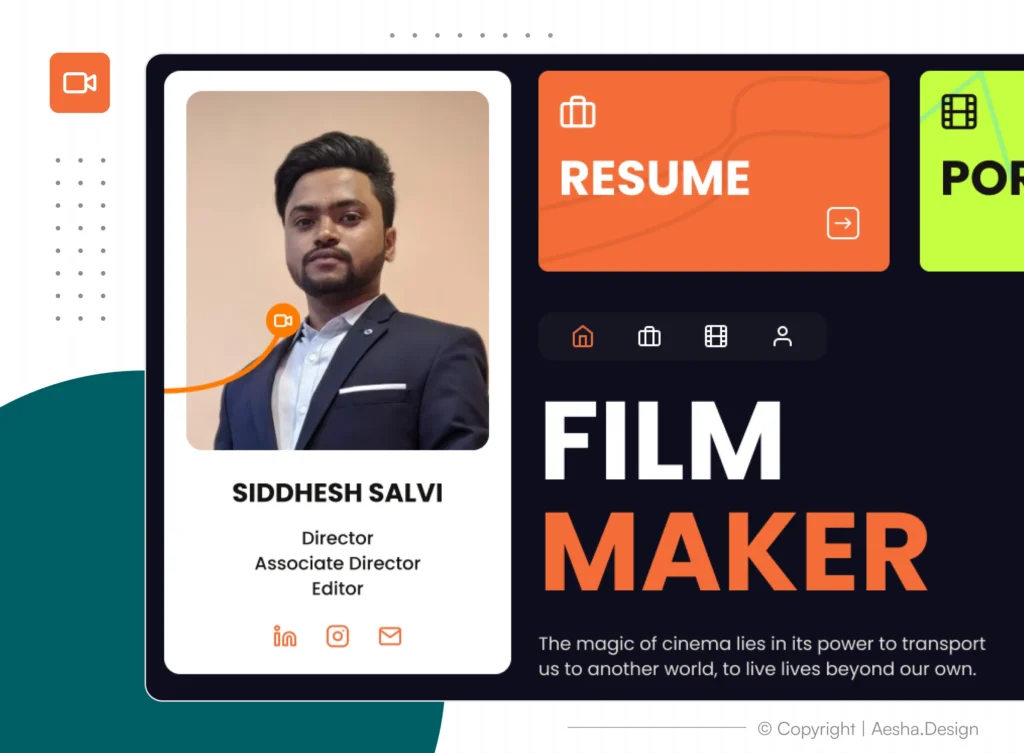
Here’s Siddhesh Salvi Films expanded and tightened — more process depth, stronger keyword density, fuller word count:
Focus Keyword: filmmaker portfolio website design
URL slug: /projects/filmmaker-portfolio-website-design-ss
SEO Title: 7 Bold Choices Behind This Filmmaker Portfolio Website Design — Siddhesh Salvi Films
Meta Description: This filmmaker portfolio website design for Siddhesh Salvi Films uses cinematic layout, editorial typography, and dark visual language to create an immersive storytelling experience.
Filmmaker Portfolio Website Design: Siddhesh Salvi Films Case Study
Filmmaker portfolio website design is one of the few briefs in digital design where the website itself has to function as a piece of filmmaking. It can’t just show the work — it has to embody the sensibility behind it. The layout, the typography, the pacing of the scroll, the way images reveal themselves — all of it has to feel like it was made by someone who thinks in frames.
Siddhesh Salvi is an independent film director whose work sits between raw storytelling and deliberate visual craft. He needed a portfolio that didn’t look like a portfolio — something that felt like entering his world, not browsing a showreel directory.
Category: Website Design · Front-End Collaboration Duration: 6 weeks Role: Creative Direction, UI Design, Prototype Deliverables: Creative Direction · Visual Identity · Website Design · Typography System · Image Treatment System · Interaction Design · Prototype · Front-End Collaboration
Table of Contents
- Overview
- The Challenge
- Problem Space
- Process
- Outcome
- Key Takeaway
1. Overview
Most filmmaker portfolio websites fail in one of two ways. The first is the full-dark dramatic approach — near-black backgrounds, white type, dramatic imagery — that looks cinematic for approximately three seconds before it starts to look like every other filmmaker’s site. The second is the safe clean approach — white backgrounds, grid layouts, neutral typography — that communicates nothing distinctive about the sensibility of the person behind the work.
Neither was right for Siddhesh. His films have a specific visual signature — considered, layered, emotionally precise. The filmmaker portfolio website design needed to carry that signature into a digital space without defaulting to either failure mode.
The goal: build a website that functions as a mood piece first and a portfolio second. Immersive, editorial, designed to hold attention before a single frame plays. The site needed to feel like a piece of work in its own right — not a container for work that exists elsewhere.
2. The Challenge
Filmmaker portfolio website design introduces a specific tension that most portfolio briefs don’t carry — the work being presented is time-based, but the website is not. Film exists in duration. A website exists in space. The design challenge is creating a spatial experience that communicates the same emotional register as work that unfolds over time.
The additional challenge: Siddhesh had no existing brand identity. The visual language of the website had to be developed from scratch — and it had to feel like it emerged from the work itself, not like a design system imposed on top of it. A filmmaker portfolio website design that feels designed is a failure. It should feel inevitable.
Starting from nothing also meant every decision — type, colour, image treatment, interaction model, navigation logic — had to be made without a reference point. The direction had to be derived from the films themselves. That’s both the most difficult kind of brief and the most creatively interesting.
There was also a performance tension embedded in the brief. The visual ambition — full-bleed imagery, custom treatments, atmospheric depth — had to coexist with fast load times and smooth scroll. A filmmaker portfolio website design that loads slowly loses its atmosphere before it has the chance to create it.
3. Problem Space
- No existing brand identity; complete visual language to be developed from scratch.
- Client wanted cinematic atmosphere without defaulting to templated dark-portfolio conventions.
- Content-heavy brief: film stills, trailers, press credits, behind-the-scenes material — all requiring clear hierarchy without cluttering the experience.
- Site needed to feel visually rich while loading fast — a performance constraint that directly conflicts with the visual ambition of the brief.
- Front-end collaboration required — design decisions had to account for technical implementation constraints from the start.
- No reference sites the client liked — direction had to be derived entirely from the work itself.
- Navigation needed to feel like part of the editorial experience, not a functional overlay on top of it.
4. Process
Creative Direction: Defining the Filmmaker Portfolio Website Design Language
Before any interface work, a visual direction document was developed from the films themselves. Colour temperature, compositional tendencies, emotional register, recurring visual motifs — all mapped and translated into a set of design principles specific to this filmmaker portfolio website design.
Three principles emerged from that analysis:
Atmosphere before information.
The first thing a visitor experiences should be emotional, not navigational. Information follows atmosphere — it never leads it.
Restraint as sophistication.
Siddhesh’s films don’t explain themselves. The website shouldn’t either. Every element present has to earn its place. Nothing decorative. Nothing that competes with the work.
The reveal as a design mechanism.
In filmmaking, withholding information is a storytelling tool. The website uses the same logic — content reveals itself through scroll and interaction rather than presenting everything simultaneously.
These principles governed every subsequent filmmaker portfolio website design decision. When a design choice was in question, these three statements resolved it.
Typography as Atmosphere
An extended serif display face was selected for project titles — set at large scale, generous tracking, with enough visual weight to carry the page before imagery loads. The type itself creates atmosphere. On a slow connection, the typographic moment is the first impression. It had to be strong enough to hold that position independently.
Body copy and UI elements set in a clean geometric sans — precise, invisible, structural. The contrast between the display serif and the functional sans creates the same tension as the films themselves: emotional weight held in precise formal structure. Typography in this filmmaker portfolio website design does more than label content — it establishes register before a single image loads.
Image Treatment System
Film stills presented at full bleed — never cropped into thumbnails, never reduced to card format. A custom overlay system desaturates images on scroll entry, then snaps into full colour on hover. The effect creates a reveal moment for every project — a small piece of film logic applied to a static image.
This image treatment system is the most distinctively cinematic decision in the filmmaker portfolio website design. It borrows the language of the medium being presented — the transition from desaturated to colour, from still to alive — and applies it to the browsing experience itself. The site doesn’t show films. It behaves like one.
Image treatments are CSS-based rather than JavaScript-dependent — they apply instantly without render blocking, keeping the performance constraint intact without sacrificing the visual effect.
Navigation as Editorial Index
Instead of a standard header navigation, projects are listed in a left-rail editorial index that scrolls independently of the main canvas. The layout is borrowed from editorial magazine design — specifically from film and photography publications where the index is a designed object, not just a functional list.
The navigation decision in this filmmaker portfolio website design is a statement about how the work should be approached. An index implies a body of work with weight and history. It positions the portfolio as a catalogue of a practice — not a collection of individual pieces assembled on a page.
Dark but Not Uniform
The colour system uses three tonal ranges rather than a single dark background — a deliberate move away from the flat monochrome that makes most dark portfolio sites feel identical to each other.
Near-black for structural frames. Deep charcoal for content areas. A single warm accent used only on hover states and active selections — present enough to create depth and life, restrained enough never to compete with the imagery.
This tonal layering is what separates a considered filmmaker portfolio website design from a templated dark aesthetic. The difference between three related darks and one flat dark is the difference between atmosphere and a colour choice. One feels inhabited. The other feels applied.
Performance Without Compromise
A progressive loading strategy was implemented throughout: low-resolution placeholder images load immediately, full resolution loads progressively as the user scrolls. The result is a site that feels as fast as it looks considered — atmosphere doesn’t wait for assets to load, it begins the moment the first element renders.
[Insert Project Image Here]
Filmmaker portfolio website design for Siddhesh Salvi Films — cinematic layout, editorial typography, custom image treatment system, and left-rail navigation.
5. Outcome
- Site launched within the 6-week window with zero post-launch critical revisions.
- 3× increase in inbound project enquiries within 30 days of launch.
- Bounce rate reduced 40% compared to the previous site — users arriving and staying rather than scanning and leaving.
- Average session duration increased significantly — visitors spending time with the work as intended.
- Site featured in two regional design showcases within the first quarter post-launch.
- Client reported the site consistently referenced in new client conversations as a credibility signal — prospects mentioning the website before mentioning the films.
- Front-end collaboration completed on schedule with zero design-to-development translation issues — design constraints were built into the system from the start.
See editorial layout thinking applied to a different visual industry →
6. Key Takeaway
The most important decision in this filmmaker portfolio website design wasn’t a visual one. It was the decision to derive the design language from the films rather than from design references. When the visual system emerges from the work itself — from its colour temperature, its compositional logic, its emotional register — the resulting website feels like an extension of the practice rather than a container for it.
That’s the standard every filmmaker portfolio website design should be held to. Not: does it look cinematic? But: does it feel like this specific filmmaker made it?
Achieving that specificity, from scratch, in six weeks, required a process that started with the work and moved outward — not a process that started with references and moved inward. Restraint is a design decision. Every element on the final site earned its place through at least two rounds of deliberate cuts. The site is better for every single one of them.